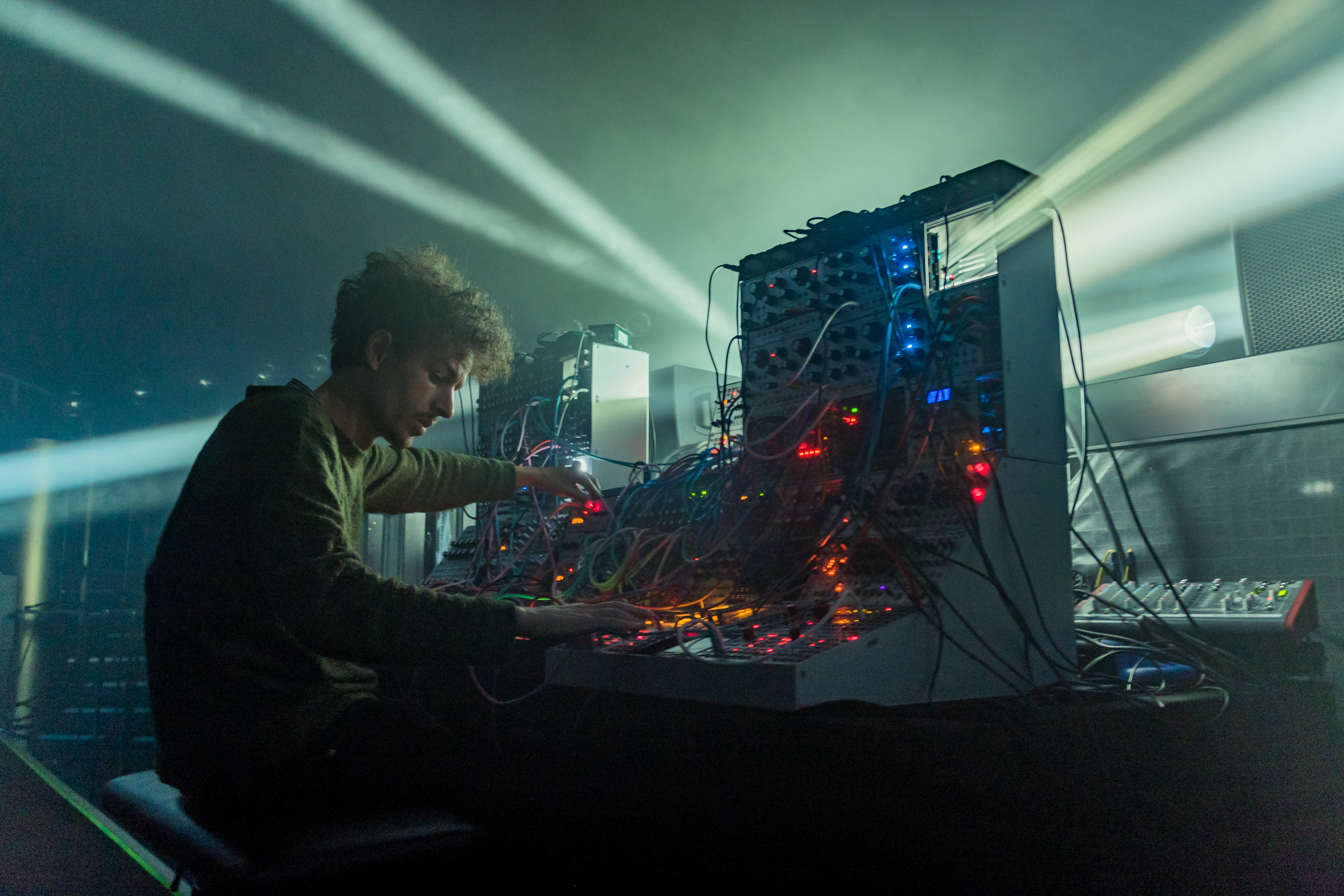

For Owen Sanders, Rally Is a Way To Be As Generous as Possible
Owen Sanders has always pushed the boundaries of music making. Before he got into modular synthesizers, he was the founder and conductor of the unprecedented Kyteman Orchestra, a 30-piece group that included 10 rappers among its orchestral ranks. But eventually, Benders wanted to break out on his own and double down on his passion for electronic music. When he took that leap back in 2013, he wasn’t sure where it would lead—but by following his instincts and eventually getting swept up by the possibilities of modular synths, he was able to establish himself as a touring musician with a huge community of enthusiasts fueling his work.
Once the pandemic hit, Benders’ touring was brought to a halt. This didn’t dampen his enthusiasm, though. Instead, he re-committed to streaming his craft in action, and created a digital safe haven for his community to virtually gather in as COVID-19 sent everyone into lockdown.
Now, Benders is an all-in streamer, often going live for three- or four-hour sets. His on-stream exuberance and talent have helped him build a thousands-strong community who support his work wholeheartedly, and once he joined Rally, his fans were immediately there to scoop up his Coin, $VCA. Benders is just getting started with developing the perks of holding his Coin, but already, his community is pumped that they’ll be able to use $VCA to make donations on stream, buy music and tickets, and eventually get access to a massive music library—dubbed The Vault—full of recordings, stems, and other music that’s there just for them to enjoy.
Below, we caught up with the electronic musician to hear more about why he wants to ensure his streams and community channels are free and open to everyone, and how he balances his commitment to generosity with his need to make a living.
Can we start with an introduction to you as a creator? What kind of work do you make?
For my whole life, everything I’ve done has revolved around making and performing music. I used to work with orchestras, then I was a conductor for a big group, and I even wrote music for operas for a while. But for the last few years, I've fully focused on making electronic music—specifically with a modular machine.
What compelled you to make the switch to electronic music?
When I started out as a musician, I was solely focused on classical and jazz. But from there, I discovered hip hop, drum and bass, and other electronic genres. I've always been interested in the emotion and energy behind a piece of music more so than its style or genre, and I was immediately mesmerized by the energy that came with electronic music. So when I started trying to compose electronic stuff for myself, I was always searching for what kinds of sounds fit best to a certain energy or certain flow, and what I could do with that.
In the beginning, my first go-to point was starting with orchestral instruments, and adding in drums and other electronic sounds to expand what was possible. But at some point I hit this roadblock where I realized I was missing the electronic grit that bands like R. Falkenberg or Justice had. There was always a different drive and energy behind their music that I wasn’t able to achieve.
At that point, I was looking for a better sound than just what I could make with my computer, which sounded plastic and thin to me. Then a friend suggested, "Why don't you try using modular synthesizers?" Once I started researching them, I got really excited and bought way too many modules without a clue of how to use them. When everything arrived, all the gear just sat in the corner of my room for something like a year before I gave it a serious try. But once I focused on figuring it out, I got more and more interested in the results.
The deeper I went with it, the more intense it got. I am quite an obsessive person, so especially when it comes to something I really like, I can totally lose myself in it. That's what happened with modulars—to the point that I disbanded my orchestra and stopped doing everything else. I think that was something like eight years ago now, and I'm still doing it today.
Once you found electronic music and modular synths, how did you take it all online? You've got a big following built up—was building that community an intentional process?
I started streaming for the first time somewhere around 2015, when I had just disbanded the orchestra. It was the first time I was without an official project to work on, but every day, I kept going back to the modular wall and just jamming and trying to figure out where to take it. At some point I found out about this online radio thing called Mixlr, and started streaming audio. The first time I did it, there were maybe five people who tuned in. But even then, I noticed it changed how I worked. Having someone listening to what I was doing added this little edge of tension to everything, like, "Don't mess up." I got hooked.
A couple of weeks later I added some webcams and started streaming on YouTube and on Facebook. From there, things took off pretty fast, and I started getting bookings to do shows and big techno festivals all over. While I was on the road performing, the streaming stopped.
Then last year, as different countries started going into early-pandemic lockdown, I decided, “We might be in lockdown for a while. Before that happens, I’m gonna grab my essentials from my studio.” So I brought my modular home, in addition to my camera gear. That was when I decided to start streaming again.
In that first week of lockdown, a lot of people tuned into the stream, and it gave some structure to my days. I would wake up, fire up the camera and the synth, and just start playing. It was like, “Nobody knows what’s going to happen, but at least you can chill out here with me.” The community just kept coming back and having their morning coffee with me and with each other. Before I knew it, there were something like a thousand people in the Discord channel, all just meeting each other and talking about everything and nothing at the same time. It was like we had established this online community away from everything else.

